
tardits (0.2.2)
Installation
pip install --index-url About this package
Text And Rotating Dimensions In Token Space
Text And Rotating Dimensions In Token Space
or: how to make LMs bigger on the inside
Welcome to TARDITS, a library exploring (tiny) Complex-Valued LM architectures. It's my take on the awesome Let's build GPT tutorial. After finishing my GPT-net and updating it (RoPE, swiGLU, RMSNorm...), I got the idea to write a complex transformer. Mainly because I asked myself if they really need an activation function... turns out they don't 🤯
After a few iterations, the $\mathbb{C}$-net got surprisingly stable. Of course, I had to try quaternions (\mathbb{H}) next. They were built using the Cayley-Dickson construction — so I pass 2 complex values through the transformer and let PyTorch do all the backprop work. Then the concept escalated a little, and the Octonion (\mathbb{O}) and Sedenion (\mathbb{S}) nets also somehow happened. Both work, but they take a really long time to train. Especially on CPU :D
There may be better uses for CVNNs than predicting text... but why not Shakespeare?
🙃 Architecture
Click to expand 🔻
⛵ SAIL (Self-Activating Interference Layer)
The main idea. In standard $\mathbb{R}$-nets, non-linear activation functions (like GELU or SwiGLU) in the feed-forward layer are strictly necessary. However, multiplying two complex numbers is inherently non-linear in itself. SAIL is essentially SwiGLU without the "Swi": It splits the input via a Linear Layer into two parts and multiplies them together. That alone is sufficient to get a fully trainable complex transformer. Combined with residual connections z = z + SAIL(z), my guess is it could also be chaotic somehow (think Mandelbrot set).
🪢 GyRoPE - learnable RoPE, full circle
While implementing experimenting with RoPE in my $\mathbb{R}$-net, I found that a trainable RoPE initialized randomly from -2\pi to 2\pi yielded results comparable to classical positive positional encodings. This proved to work nicely with the complex transformers. However the weights are few and they change really slowly during training.
- $\mathbb{C}$-RoPE rotates in the
2\mathcal{D}complex plane. - $\mathbb{H}$-RoPE rotates around a unit 3-sphere (
S^3). \mathbb{O}and\mathbb{S}rotate around their respective hyperspherical counterparts.
👀 Attention
How do you route attention in complex spaces? I experimented with various variants, but turns out: simplicity wins. Attention scores are computed via the Hermitian dot product (Q K^\dagger). By extracting only the real component before applying the causal mask and standard Softmax:
# In C-Space:
wei = (q @ k.adjoint()) * (2 * self.head_size) ** -0.5
wei = wei.real
wei = F.softmax(wei.masked_fill(self.tril[:T, :T] == 0, float("-inf")), dim=-1)
# Weighted value aggregation remains hypercomplex:
out = wei.to(v.dtype) @ v
The real part perfectly captures the phase alignment and magnitude between queries and keys after multiplication, acting as a natural scalar affinity score. The resulting real weights are then used to scale the full complex/hypercomplex value vectors (V). No other variant yielded a better validation loss so far.
🏋️ Weight Initialization
Attention and SAIL weights are initialized around the unit circle/sphere and scaled by:
\sqrt{\frac{S}{d_{in} + d_{out}}}(where S is \mathbb{C}=1.0, \mathbb{H}=0.5, \mathbb{O}=0.25, \mathbb{S}=0.125)
🛌 Embedding & LM-Head
To map tokens into hypercomplex spaces, I used separate embedding tables - one for each real component (e.g., 4 tables for \mathbb{H}, 16 for \mathbb{S}) and initialized them with a scaled normal distribution (Var = 1.0):
# Quaternion Embedding (4D)
z1 = torch.complex(emb_r1(x), emb_i1(x))
z2 = torch.complex(emb_r2(x), emb_i2(x))
---
 nn.init.normal_(emb.weight, std=(1 / math.sqrt(4)))
To project back to vocabulary logits, the LMHead simply flattens all complex components back to \mathbb{R}:
features = torch.cat([z1.real, z1.imag, z2.real, z2.imag], dim=-1)
return self.lin(features)
🛡️ RMSNorm - Norming Amplitudes, Preserving Phases
🧨 remove for exploding transformer noises (NaN) 💥
Standard normalization layers can easily distort geometric phase information in complex spaces.
The custom RMSNorm calculates the Root Mean Square solely based on vector magnitudes (\Vert{}q\Vert{}^2 = \vert{}z_1\vert{}^2 + \vert{}z_2\vert{}^2):
# Calculate quaternion amplitude squared
ampsq = (z1 * z1.conj()).real + (z2 * z2.conj()).real
rms = torch.rsqrt((ampsq / 2.0).mean(dim=-1, keepdim=True) + self.eps)

return (z1 * rms) * self.weight, (z2 * rms) * self.weight
This scales feature amplitudes cleanly across layers while leaving phase angles completely intact.
🔥 Hot Curves (Benchmarks & Results)
Click to expand 🔻
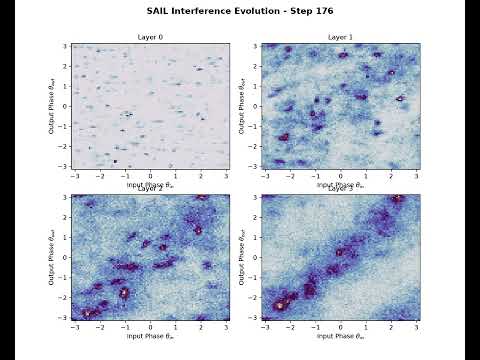
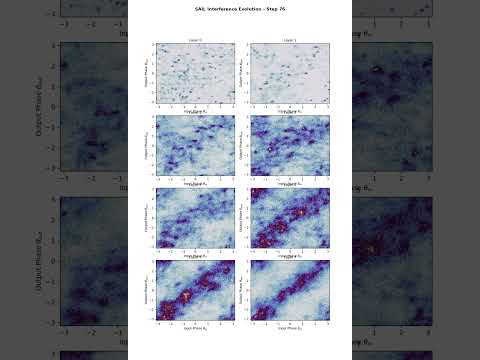
🌊 SAIL Interference Patterns (\mathbb{C})
🎬 2D SAIL Interference Evolution
🎬 3D SAIL Phase-Amplitude Topography
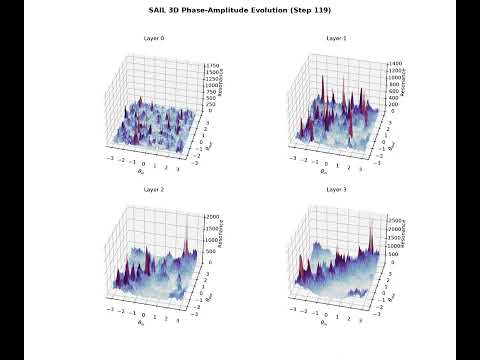
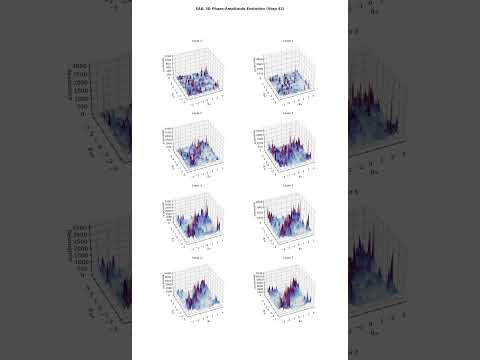
Figure: Evolution of selective phase interference across all 8 Transformer layers over training steps. Deep layers (6 & 7) demonstrate extreme destructive phase cancellation alongside razor-sharp resonance peaks (> 10,000 amplitude). That's why the Post-Norm design makes a lot of sense here
📉 Comparison Runs
shared parameters:
| batch_size | block_size | dropout | learning rate | vocab_size |
|---|---|---|---|---|
| 32 | 128 | 0.2 | 0.0005 | 65 |
\mathbb{C} vs \mathbb{R} / both ~180k params
| Model | Space | n_{embd} |
Layers | Heads | Params | Train Loss | Val Loss |
|---|---|---|---|---|---|---|---|
| ComplexGPT | \mathbb{C} |
54 | 4 | 6 | ~179k | 1.472 | 1.704 |
| RealGPT | \mathbb{R} |
60 | 4 | 6 | ~181k | 1.526 | 1.759 |
\mathbb{R} vs the complex rest
Number of parameters scaled. Note: the higher dimensional runs take forever. A "Sedenion" needs 256 multiplications instead of one.
| Model | Space | n_{embd} |
Layers | Heads | Params | Train Loss | Val Loss |
|---|---|---|---|---|---|---|---|
| RealGPT | \mathbb{R} |
96 | 5 | 6 | ~567k | 1.367 | 1.645 |
| ComplexGPT | \mathbb{C} |
72 | 5 | 6 | ~384k | 1.359 | 1.633 |
| QuaternionGPT | \mathbb{H} |
54 | 4 | 4 | ~356k | 1.367 | 1.633 |
| OctonionGPT | \mathbb{O} |
32 | 4 | 4 | ~264k | 1.398 | 1.668 |
| SedenionGPT | \mathbb{S} |
18 | 4 | 6 | ~184k | 1.460 | 1.702 |
v0.2.0 Bonus - Centumduodevigintunions 🔻
🚀 Quickstart & Usage
Install
pip install tardits
# or
uv add tardits
Optional - for MLFlow experiment tracking:
pip install tardits[mlflow]
Quickstart
Example configuration (save as .yaml):
device: "auto" # Choices: "auto", "cuda", "cpu", "mps"
seed: 1337

model:
  level: 1 # Complex
  block_size: 64
  n_head: 6
  n_embd: 42
  n_layer: 4
  dropout: 0.2

trainer:
  batch_size: 32
  max_iters: 5000
  eval_interval: 500
  learning_rate: 0.0005
  eval_iters: 200
  save_interval: 0
  checkpoint: "saved_model.pt"

mlflow:
  experiment: "" # add name to enable
  log_interval: 10
  deep_log_interval: 0
  system_metrics: false

data:
  input_path: "my_training_data.txt"
  vocab_save_path: "saved/charset.txt"
You can also take a config from [examples/configs] and the shakespeare.txt form [examples/data]
Start Training
ttrain -c config.yaml
Generate Text
tgen -c config.yaml -p "To be or not to be" -l 200

tgen -h
options:
  -h, --help            show this help message and exit
  --config, -c CONFIG   Path to YAML configuration file
  --checkpoint CHECKPOINT
                        Optional override for model checkpoint path
  --vocab VOCAB         Optional override for vocab path
  --prompt, -p PROMPT   Text prompt to start generation
  --length, -l LENGTH   Number of tokens to generate
  --temp, -t TEMP       Model sampling temperature
  --top_k, -k TOP_K     Top-k sampling threshold
  --follow, -f          Endless stream of tokens
  --delay DELAY         Delay between tokens in follow mode (seconds)
v0.2.0 (Current Release)
- Dynamic Dimension Scaling: Universal recursive Cayley-Dickson engine (
2^kdimensions, up to 128D Centumduodevigintunion) - Package Refactoring: Clean library structure for distribution
- CLI Tools: Easy executions via
ttrainandtgen - PyPI Release: Official package published on PyPI
🧭 Outlook v0.3.0 - Tesseract
- Logit Distillation Engine:
DistillTrainersupporting dynamic teacher-student logit alignment (e.g., SmolLM2) - Synth Training Data: script to generate customized synthetic training data
- Interactive TUI:
Simpleamazing terminal-based chat interface (usingprompt-toolkit) - Basic Inference API + docker/compose
- Tesseract Model Series: Releasing small-footprint complex chat models (2D/4D) on HuggingFace
- Getting distracted by SAIL-experiments for possible future releases 🤫🧪⛵