- Python 100%
| Filename | Latest commit message | Latest commit date |
|---|---|---|
 pvl
7d0669bdf7 release: tardits 0.3.0 - RAT: linear fast-weight attention, learned complex decay, chunked causal prefill, O(1) decode. - Tests: 60 passed, 47 subtests (forward/step equivalence, prefill/generate, registry). - FineWeb evidence: RAT33 3e-4/34k mean 1.2361 vs Real48 1e-4/36k mean 1.2355, 31% fewer RAT parameters. - README in English plus de/cs/ru/zh; legacy plots restored locally. - CI: tests on push; build + publish only on v* tags. Co-authored-by: dsh <dsh@pvlb.dev> Reviewed-on: #4 |
||
| .forgejo/workflows | ||
| benchmarks | ||
| docs | ||
| examples | ||
| src/tardits | ||
| tests | ||
| .gitignore | ||
| .python-version | ||
| AGENTS.md | ||
| LICENSE | ||
| pyproject.toml | ||
| README.cs.md | ||
| README.de.md | ||
| README.md | ||
| README.ru.md | ||
| README.zh.md | ||
| uv.lock | ||
Text And Rotating Dimensions In Token Space
or: how to make LMs bigger on the inside
🇬🇧 English | 🇩🇪 Deutsch | 🇨🇿 Čeština | 🇨🇳 中文 | 🇷🇺 Русский
 Home repo - https://git.pvlb.dev/ml-lab/tardits
<GitHub mirror: https://github.com/pvlb-dev/tardits>
Welcome to TARDITS, a small lab for Complex-Valued language models!
v0.3.0 adds RAT - a Recurrent Attention Transformer: softmax attention is replaced by a linear fast-weight memory with a learned complex decay. The state is fixed-size, generation is O(1) per token, and there is no KV-cache growth. It is a different trade-off, not a free win: at tuned LR, RAT33 ties the 48M RealGPT on FineWeb mean validation loss with 31% fewer parameters, and RAT is much faster at long-context decode. Both still have clear retrieval and interpretability limits. The honest results, including the nulls, are linked below.

The v0.3.0 evidence table and honest limitations are in docs/index.md. The FineWeb runs, data-order rerun and the RAT-vs-Real comparison supersede the old Shakespeare-only story. More RAT/HyperFormer documentation and bigger runs are on the way; this release is the starting point, not the final word.
How it started - the v0.0.0 story 🔻
TARDITS started as my take on the awesome Let's build GPT tutorial. After finishing my GPT-net and updating it (RoPE, SwiGLU, RMSNorm...), I got the idea to write a complex transformer. Mainly because I asked myself if they really need an activation function... turns out they don't 🤯
After a few iterations, the \mathbb{C} -net got surprisingly stable. Of course, I had
to try quaternions (\mathbb{H}) next. They were built using the Cayley–Dickson
construction - so I pass 2 complex values through the transformer and let PyTorch do all
the backprop work. Then the concept escalated a little, and the Octonion (\mathbb{O})
and Sedenion (\mathbb{S}) nets also somehow happened. Both work, but they take a
really long time to train. Especially on CPU :D
There may be better uses for CVNNs than predicting text... but why not Shakespeare?
🙃 Architecture
Click to expand 🔻
🐀 v0.3.0 - RAT (current)

RAT block. Rattention keeps a fixed-size complex fast-weight state with a
learned decay γ; SAIL is the activation-free feed-forward path.
RAT replaces the softmax/KV path with a linear fast-weight memory:
S_t = S_{t-1} ⊗ gamma + v_t ⊗ conjugate(k_t)
out_t = (S_t ⊗ q_t) * scale -> out_proj
gamma is learned per state element; its magnitude is the memory horizon and its
phase rotates associations. This is the LinA prototype integrated into tardits.
What is special about it
- Fixed-size state: decode is O(1) per token and there is no growing KV cache; prefill is O(T) with a chunked causal scan.
- Memory and position in one parameter: the complex decay carries both the forgetting horizon and the relative phase; no separate absolute position table.
- Activation-free: the same SAIL block and hypercomplex embedding stack work without an MLP activation.
- Honest limits: at 11M–45M params RAT is competitive on FineWeb and much faster at long decode. NIAH/retrieval is a clean null for both RAT and RealGPT at the current scales; scaling and better NIAH tests are in progress. The trigger/gating probes are research notes, not capabilities.
🧬 v0.2.0 - HyperFormer

HyperFormer block. GyRoPE rotates q/k, scores use the real part of the Hermitian product, and attention weights stay real while values stay hypercomplex.
HyperFormer is the predecessor and the general hypercomplex path: the same block is
instantiated at Cayley–Dickson levels ℂ, ℍ, 𝕆 and 𝕊. It keeps causal full-window
attention (no KV cache in the current implementation, no O(1) decode claim), uses
GyRoPE for position, and takes the real part of QK† as the softmax score.
🧩 Modules
⛵ SAIL (Self-Activating Interference Layer)
In standard \mathbb{R} -nets, nonlinear activation functions in the feed-forward
layer are strictly necessary. A complex linear layer is still linear; the nonlinearity
in SAIL comes from multiplying two projections of the same input:
SAIL(z) = (W₁z) ⊗ (W₂z), which is quadratic. It is essentially SwiGLU without the
"Swi": split via two linears, multiply hypercomplexly, then project. Combined with
residual connections z = z + SAIL(z), that is enough for a trainable complex
transformer.
🪢 GyRoPE - learnable RoPE, full circle
While implementing experimenting with RoPE in my \mathbb{R} -net, I found that a
trainable RoPE initialized randomly from -2\pi to 2\pi matched classical
positional encodings. It works nicely with the complex transformers, though the
weights are few and change slowly.
\mathbb{C}-RoPE rotates in the2\mathcal{D}complex plane.\mathbb{H}-RoPE rotates around a unit 3-sphere (S^3).\mathbb{O}and\mathbb{S}rotate around their respective hyperspherical counterparts.
👀 HyperAttention
How do you route attention in complex spaces? Simplicity wins. Scores use the
Hermitian dot product (Q K^\dagger); take only the real component, apply the
causal mask and standard softmax:
# In C-Space:
wei = (q @ k.adjoint()) * (2 * self.head_size) ** -0.5
wei = wei.real
wei = F.softmax(wei.masked_fill(self.tril[:T, :T] == 0, float("-inf")), dim=-1)
# Weighted value aggregation remains hypercomplex:
out = wei.to(v.dtype) @ v
The real part captures phase alignment and magnitude, acting as a scalar affinity score; the real weights then scale the full hypercomplex value vectors.
🐀 Rattention
Rattention is the linear fast-weight module: q/k/v projections, a per-head complex
state, S_t = S_{t-1} ⊗ γ + v_t ⊗ k̄_t, and the readout (S_t ⊗ q_t)·scale.
forward (training) and recurrent step (generation) are cross-checked by tests.
🏋️ Weight Initialization
Attention and SAIL weights are initialized around the unit circle/sphere and scaled by:
\sqrt{\frac{S}{d_{in} + d_{out}}}where S is \mathbb{C}=1.0, \mathbb{H}=0.5, \mathbb{O}=0.25, \mathbb{S}=0.125.
🛌 Embedding & LM-Head
Tokens map into a complex hypercomplex tensor with one real/imaginary pair per
complex component; the LM head flattens all real/imaginary components back to
\mathbb{R} logits.
🛡️ RMSNorm - norming amplitudes, preserving phases
🧨 remove for exploding transformer noises (NaN) 💥
Standard normalization can distort geometric phase information in complex spaces.
The custom RMSNorm computes the RMS from vector magnitudes
(\Vert q\Vert^2 = |z_1|^2 + |z_2|^2) and rescales amplitudes while leaving phases intact.
🔥 Hot Curves (Benchmarks & Results)
Click to expand 🔻
🌊 SAIL Interference Patterns (\mathbb{C})
🎬 2D SAIL Interference Evolution
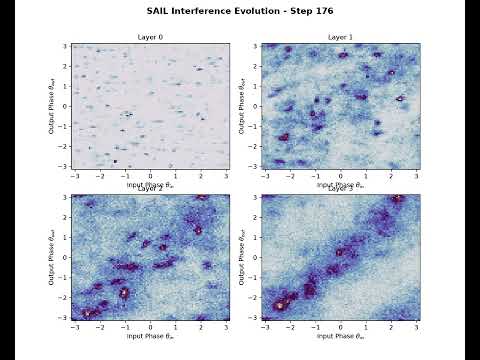
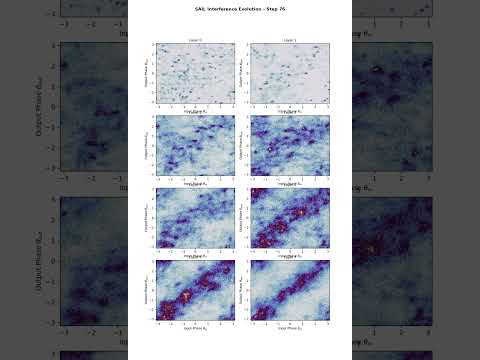
🎬 3D SAIL Phase-Amplitude Topography
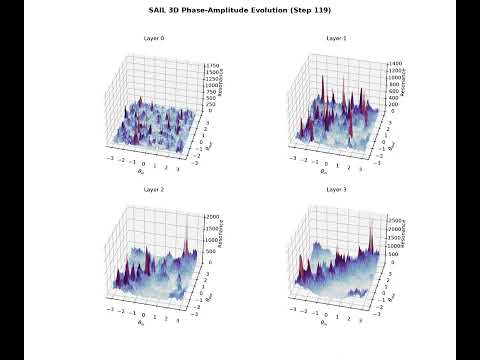
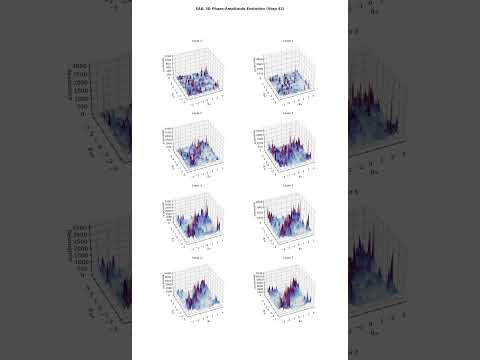
Figure: Evolution of selective phase interference across all 8 Transformer layers over training steps. Deep layers (6 & 7) demonstrate extreme destructive phase cancellation alongside razor-sharp resonance peaks (> 10,000 amplitude). That's why the Post-Norm design makes a lot of sense here
🧪 FineWeb - RAT vs RealGPT
Char-level FineWeb, 90.1M chars per arm, block 1024, batch 4. Rows are 22k iterations unless noted; all use the data-order fix. The RAT L1 rows were trained with the stable #23 scan.
| model | lr | steps | params | chars/param | val loss | note |
|---|---|---|---|---|---|---|
| RAT L1 33.4M | 3e-4 | 34k | 33.37M | 4.2 | 1.2357 / 1.2364 | mean 1.2361, two seeds |
| RealGPT 48.1M | 1e-4 | 36k | 48.09M | 3.1 | 1.2485 / 1.2225 | mean 1.2355, two seeds |
| RAT L1 33.4M (22k) | 3e-4 | 22k | 33.37M | 2.7 | 1.2540 / 1.2902 | older short run |
| RAT L1 44.8M | 3e-4 | 22k | 44.76M | 2.0 | 1.2911 | 1.6× wall-clock vs Real |
| RAT L1 11.2M | 3e-4 | 22k | 11.24M | 8.0 | 1.2845 | data-order-fixed rerun |
| RealGPT 11.1M | 3e-4 | 22k | 11.13M | 8.1 | 1.3253 | data-order-fixed rerun |
| HyperFormer 11.2M | 3e-4 | 22k | 11.2M | 8.0 | 1.2950 | 8-head control |
| RAT 6.47M | 3e-4 | 22k | 6.47M | 13.9 | 1.3669 | degradation point |
| RealGPT 48.1M (old) | 3e-4 | 22k | 48.09M | 1.9 | 1.5523 | same model, wrong LR |
At tuned LR and comparable budget, RAT33 and Real48 are tied on mean val: 1.2361 vs 1.2355, a 0.0006 difference. RAT33 does it with 31% fewer parameters, but its two seeds are almost identical (0.0007 spread) while Real's spread is ~0.026. The honest claim is parity / parameter efficiency, not "RAT wins" or "Real wins".
The LR searches were symmetric in the end: Real48 1e-4 beat 3e-4/5e-4; RAT33 3e-4 beat 1e-4. Earlier Real-vs-RAT headlines using 3e-4 on both sides were LR-confounded. RAT44 is width-dependent, not a wrong-LR control: 1e-4 helped it (3e-4 1.2911 -> 1e-4 1.2675 at 26.5k), while 1e-4 hurt RAT33 (1.2874) and RAT22 (1.3199).
Caveat: the token budgets are close but not identical (RAT 139.3M chars, Real 147.5M). Retrieval beyond the window is a clean null for both models at these scales (NIAH); scaling and better NIAH tests are in progress, so long-context claims stay speed-only for now.
📈 Width scaling

Width sweep at 9 layers. 11.2M is the surprising point - inside the 33M seed range and tied with 44M on this run; 6.47M degrades. The 11M point in the table above is the later data-order-fixed rerun, so the curves are directional, not another seed-replica.
🧠 What RAT does well (research preview)
A tiny 143k-param RAT trained on one 512-char random text reproduces the entire
remaining string from a 16- or 32-char prompt (teacher-forced accuracy 0.996–0.998),
while the matched RealGPT fails just past its trained block. That is a relative-position
/ recurrent-state effect, not a general long-context capability: NIAH’s adjacent-copy
control still fails, and a namespace-clean trigger probe shows RAT can memorise a
payload but cannot reliably gate on the trigger. The full story, including the failed
controls, is in
docs/experiments/2026-11-04-memorize.md
and docs/experiments/2026-11-05-trigger.md.
Bigger runs and more RAT documentation are in progress.
⚡ Decode speed

Decode only, KV-cached RealGPT baseline. This is the older small-scale (0.9M) shakespeare benchmark: RAT L1 is roughly flat (~317–363 tok/s) while RealGPT falls from ~392 to ~215 tok/s over 16→2048. The big-model T4/CPU numbers are below.
Big-model throughput & memory (B=8, 2048 tokens)

| model | decode tok/s | peak GB | vs Real memory |
|---|---|---|---|
| RAT22 | 782 | 0.48 | ~7.1× less |
| RAT33 | 624 | 0.62 | ~5.5× less |
| RAT44 | 621 | 0.66 | ~5.2× less |
| Real48 | 487 | 3.43 | 1× |
This is the trade-off in one table: at single-stream/short context Real48 is faster (96 vs 77 tok/s) and RAT44 is slower, but at batch 8 / 2048 RAT33/44 are ~1.25× faster and use one-fifth of the memory. RAT22 is the throughput winner at one-seventh of the memory, with weaker quality. See the full speed report.
🎚️ Learned decay

Per-layer learned |γ| in the final L1 shakespeare checkpoint: the model chooses
short horizons (~8–13 tokens) rather than one global decay. A small model on tiny
data, but it shows the parameter is doing real work; the long-context/state audit
lives in RAT decay and
state probe.

Poster frame from the learned-decay evolution video; the MP4 is linked from the docs.
📉 Shakespeare runs (older)
shared parameters:
| batch_size | block_size | dropout | learning rate | vocab_size |
|---|---|---|---|---|
| 32 | 128 | 0.2 | 0.0005 | 65 |
\mathbb{C} vs \mathbb{R} / both ~180k params

| Model | Space | n_{embd} |
Layers | Heads | Params | Train Loss | Val Loss |
|---|---|---|---|---|---|---|---|
| ComplexGPT | \mathbb{C} |
54 | 4 | 6 | ~179k | 1.472 | 1.704 |
| RealGPT | \mathbb{R} |
60 | 4 | 6 | ~181k | 1.526 | 1.759 |
\mathbb{R} vs the complex rest
Number of parameters scaled. Note: the higher dimensional runs take forever. A "Sedenion" needs 256 multiplications instead of one.
 *Figure: Training and validation loss trajectories across spaces ($\mathbb{R}, \mathbb{C}, \mathbb{H}, \mathbb{O}, \mathbb{S}$). Note how Complex-383k (green) consistently outperforms the larger Real-baseline (blue).*
| Model | Space | n_{embd} |
Layers | Heads | Params | Train Loss | Val Loss |
|---|---|---|---|---|---|---|---|
| RealGPT | \mathbb{R} |
96 | 5 | 6 | ~567k | 1.367 | 1.645 |
| ComplexGPT | \mathbb{C} |
72 | 5 | 6 | ~384k | 1.359 | 1.633 |
| QuaternionGPT | \mathbb{H} |
54 | 4 | 4 | ~356k | 1.367 | 1.633 |
| OctonionGPT | \mathbb{O} |
32 | 4 | 4 | ~264k | 1.398 | 1.668 |
| SedenionGPT | \mathbb{S} |
18 | 4 | 6 | ~184k | 1.460 | 1.702 |
v0.2.0 Bonus - Centumduodevigintunions 🔻
 It's ridiculous, pointless and I can't even spell it... but it runs (very slowly). The most interesting usecases may be found on level 1-3 ;)
🚀 Quickstart & Usage
Install
pip install tardits
# or
uv add tardits
Optional - for MLFlow experiment tracking:
pip install tardits[mlflow]
Quickstart
Example configuration (save as .yaml):
device: "auto" # Choices: "auto", "cuda", "cpu", "mps"
seed: 1337

model:
  arch: hyper # optional: real | hyper | rat (default: level < 1 -> real, else hyper)
  level: 1 # Complex
  block_size: 64
  n_head: 6
  n_embd: 42
  n_layer: 4
  dropout: 0.2

trainer:
  batch_size: 32
  max_iters: 5000
  eval_interval: 500
  learning_rate: 0.0005
  eval_iters: 200
  save_interval: 0
  checkpoint: "saved_model.pt"

mlflow:
  experiment: "" # add name to enable
  log_interval: 10
  deep_log_interval: 0
  system_metrics: false

data:
  input_path: "my_training_data.txt"
  vocab_save_path: "saved/charset.txt"
You can also take a config from [examples/configs] and the shakespeare.txt form [examples/data]
RAT variant
Swap the model block; the trainer and tgen are unchanged:
model:
  arch: rat
  level: 1             # complex
  block_size: 128
  n_head: 21
  n_embd: 84
  n_layer: 8
  dropout: 0.2
The reference FineWeb configs are in
experiments/configs/fineweb/ (RAT 11M/33M/45M).
Start Training
ttrain -c config.yaml
Generate Text
tgen -c config.yaml -p "To be or not to be" -l 200

tgen -h
options:
  -h, --help            show this help message and exit
  --config, -c CONFIG   Path to YAML configuration file
  --arch, -a ARCH       Override the model family selected in the config
                        (hyper | rat | real)
  --checkpoint CHECKPOINT
                        Optional override for model checkpoint path
  --vocab VOCAB         Optional override for vocab path
  --prompt, -p PROMPT   Text prompt to start generation
  --length, -l LENGTH   Number of tokens to generate
  --temp, -t TEMP       Model sampling temperature
  --top_k, -k TOP_K     Top-k sampling threshold
  --follow, -f          Endless stream of tokens
  --delay DELAY         Delay between tokens in follow mode (seconds)
v0.3.0 (Current Release) - RAT
- RAT (
arch: rat): linear fast-weight memory, learned complex decay, O(1) decode, chunked causal prefill. - RAT port + tests:
forward/stepequivalence, prefill/generate, learned-gamma scan regression, all archs. - FineWeb evidence: 11M/33M/45M RAT vs 11M/48M RealGPT, including the data-order rerun and symmetric LR treatment: RAT33 3e-4/34k mean 1.2361 vs Real48 1e-4/36k mean 1.2355, with 31% fewer RAT parameters. Historical RAT L1 rows are pre-#23; the long-run RAT33 pair is #23-clean.
- Current nulls: NIAH adjacent-copy control fails for both RAT and RealGPT; scaling and better NIAH tests are in progress, so no long-context retrieval claim yet.
- CLI + configs:
ttrain/tgenfor real, hyper, rat; MLflow tracking. - PyPI 0.3.0: release repo port is tracked in #1.
🧭 Outlook
- Text diffusion: the 0.4.0 bet - a text-diffusion model with RAT and hypercomplex variants, not another autoregressive-only release.
- Hijack distillation: frozen teacher embedding/head + RAT core; logit-KL and hidden-MSE probes (research; not a 0.3.0 feature).
- Paper: RAT method + FineWeb evidence + nulls (
paper/, after release).